

Support Connect LIMITED
Safeguarding Adults Policy and Procedure
| Policy issued | October .2025 |
|---|---|
| Policy version number | V4 |
| This Policy is for | All staff in Support Connect |
| Date of the last review | October 2025 |
| Date of the next review | October 2026 |
| Policy owners | Sophie Moore, Designated Safeguarding Lead. Caroline Fillery, Director of Support Connect. |
For the purposes of this policy and procedure, children are defined in the Children Act of 1989 as a person under the age of 18 years. An ‘adult at risk’ previously known as a ‘vulnerable adult’ is defined as an any person 18 years or over who is or appears to be eligible for assistance by reason of mental ill health, physical or learning disability, illness or age-related frailty and/or; may be unable to take care of him/herself or unable to protect him/herself against significant harm or exploitation.
Introduction
Support Connect exists to connect learners who are disadvantaged through learning difficulties, and physical or mental health conditions with the support they need to thrive in their further and higher education. We do this through working with Apprenticeship training providers, Department for Education and Student Finance England/Wales, EHCP provisions, and organisations that can access DfE and other public funding to support this provision.
We use our extensive experience of delivering assessment and support in different learning environments to provide highly specialised, individually tailored learning and mental health support services to learners with additional learning needs. This also encompasses individuals with Special Educational Needs and Disabilities (SEND) who face barriers to their learning created by a learning difference or disability.
Welcome to Support Connect | Support Connect
Support Connect is a value driven organisation. We believe that strong values are the bedrock of company culture, and they will be the central way in which we operate.
The following are Support Connect Ltd Core Values:
- TRUST - Organised, reliable, and dependable - Dedicated to our purpose not just to profit.
- INTEGRITY – Openness, honesty and being straight with each other. Loyalty to the values first.
- EMPATHY - An environment of wellbeing happiness, kindness, and mutual respect. Understand the perspectives of our clients and the learners we are supporting.
- DEVOTION - Turn up, work hard, care for those we serve.
- COMMITTED - Hard-working, confident, and knowledgeable.
Policy statement
Support Connect is committed to Safeguarding in line with national legislation and relevant national and local guidelines. It is also committed to best safeguarding practices and upholding the rights of everyone to live a life free from harm, from abuse, exploitation, and neglect.
At Support Connect we recognise that everyone, regardless of age, disability, gender reassignment, race, religion or belief, sex, or sexual orientation has an equal right to protection from all types of harm and abuse.
Support Connect acknowledges that safeguarding is everybody’s responsibility and is committed to fulfilling our duty of care towards young people and adults. This means that we must do everything that can be reasonably expected of us to help safeguard and protect them from harm, and to act when we suspect that someone is being harmed or is at risk of harm.
Actions taken by Support Connect will be consistent with the principles of safeguarding ensuring that any action taken is prompt and proportionate and that it includes and respects the voice of the person concerned.
We are committed to reviewing our policies and procedures annually, or when there is a change to legislation, or if there has been a meaningful change within the organisation. The Designated Safeguarding Lead (DSL) and the deputies are responsible for updating this policy.
The purpose and scope of the policy
The purpose of this policy and procedure is to ensure that our organisation promotes the well-being of the people we support, helps prevent them from coming to harm, abuse, or neglect, and responds effectively and timely if concerns are raised or observed. This policy and procedure demonstrates the commitment that Support Connect has to safeguarding and to ensuring that everyone involved in Support Connect is aware of:
- The legislation, policy, and procedures for safeguarding.
- Their role and responsibility for safeguarding.
- What to do or whom to speak to if they have a concern relating to the welfare or well-being of an individual who is within the organisation or accessing our services.
Support Connect aims to create and maintain a safe space for learning support to take place. This safeguarding policy applies to anyone over the age of 16 (as of their 16th birthday) who is accessing our services. Throughout this document, we use the term ‘learners’ to describe anyone over the age of 16 who accesses Support Connects services. The policy also applies to anyone working on behalf of Support Connect including Senior Managers and Directors, paid staff, agency staff, freelance staff, and learners.
This policy does not apply to any external agencies, training providers, or employers who are also involved in the learner’s journey through education. Such agencies are responsible for their Safeguarding arrangements.
Legal framework and legislation
This policy has been drawn up based on legislation, policy, and guidance that seeks to protect everyone in the United Kingdom from harm and abuse. Some of the key legislation and guidance which have been drawn on to underpin this policy are below:
- Keeping Children Safe in Education 2025
- The Human Rights Act 1998
- The Data Protection Act 2018
- The Education Act 2002 and 2011
- The Children and Families Act 2014
- Safeguarding Vulnerable Groups Act 2006
- Equality Act 2010
- Prevent Duty Guidance 2023
- Counter-Terrorism and Security Act 2015
- Health and Safety at work Act 1974
Key principles
The following enshrined principles from the Care Act 2014 underpin all of Support Connects Safeguarding principles:
- Principle 1: Empowerment = Adults are encouraged to make their own decisions and are provided with support and information.
‘I am consulted about the outcomes I want from the safeguarding process and these directly inform what happens
- Principle 2: Prevention = It is better to take action before harm occurs.
“I receive clear and simple information about what abuse is, how to recognise the signs, and what I can do to seek help.”
- Principle 3: Proportionality = Proportionate and least intrusive response appropriate to the risk presented.
“I am sure that the professionals will work for my best interests, as I see them and they will only get involved as much as I require.”
- Principle 4: Protection = Support and representation for those in greatest need.
“I get help and support to report abuse. I get help to take part in the safeguarding process to the extent to which I want and to which I am able.”
- Principle 5: Partnership = Local solutions through services working with their communities. Communities have a part to play in preventing, detecting, and reporting neglect and abuse.
“I know that staff treats any personal and sensitive information in confidence, only sharing what is helpful and necessary. I am confident that professionals will work together to get the best result for me.”
- Principle 6: Accountability and transparency in delivering safeguarding.
“I understand the role of everyone involved in my life.”
Supporting documents
This policy statement should be read in conjunction with our organisational policies, procedures, and guidance as listed below. All of these can be found on our website, Factorial and within our staff handbook:
Staff Handbook
- Employee Code of Conduct
- Equality, Diversity, and Inclusion Policy
- Data Protection and Information Sharing Policy
- Role Description for The Designated Safeguarding Lead
- Managing Allegations Against Staff
- Anti-Bullying and Harassment Policy
- Induction, Training, Supervision, and Support
- Photography and Sharing Images Guidance
Factorial
- Lone Worker Policy
- Home Working Policy
- Remote Working Policy
- Safe Storage of Physical and Electronic Records Policy
- Personal Relationships at Work Policy
- Safer Recruitment Policy
- Social Media Policy
- Whistleblower Policy
- Complaints Policy
- Clear Desk, Clear Screen Policy
- Acceptable Internet Use and Acceptable Email Use Policy
- Health and Safety Policy
- Employee Code of Conduct
- Modern Slavery Statement
- Professional Boundaries Policy
- IT Security Awareness Policy
- Security Incident Management Policy
- Right to Work in the UK Policy
- Anti- Bribery and Corruption Policy
- Dress Code Policy
- Password Policy
- AI Policy
- Access to Work Policy
- Occupational Health Policy
- Flexible working Policy
- Compassionate Leave Policy
- Menopause Policy
- Sickness Policy
- Valuing Diversity and Dignity at Work
- Reasonable Adjustments Policy
- Grievance Procedure
We seek to keep learners safe by:
Support Connect is committed to implementing this Safeguarding policy and procedure. To do this effectively the following will be in place:
- A clear line of accountability within Support Connect for the safety and welfare of all learners.
- A designated Safeguarding lead and deputy safeguarding officer/s
- Being aware of the safeguarding issues that can impact learners.
- Codes of conduct for learners and staff which specify a zero tolerance to abuse in any form.
- Adopting a culture of valuing, listening, and respecting others’ views.
- Working with and following the guidance on our internal tracking systems to record and report any safeguarding concern or incident.
- Developing and implementing an effective online safety policy and related procedures.
- Adhering to safer recruitment practices by gaining all necessary checks, including DBS checks, when selecting and recruiting staff
- Recording, storing, and using information professionally and securely, in line with data protection legislation and guidance.
- Using our procedures to manage any allegations against staff appropriately.
- Providing all staff with safeguarding training initially and yearly update refresher training.
- Ensuring that all learners and staff are aware of our Safeguarding Policy and Procedure.
- Creating and maintaining an anti-bullying environment that follows Support Connect’s Anti-bullying and harassment policy.
- Ensuring that we have effective complaints and whistleblowing measures and policies in place.
Definitions
| Safeguarding | Is the process of protecting a person’s health, well-being, and right to live in safety, free from harm, abuse, and neglect. (Safeguarding definition | Background information | Safeguarding adults in care homes | CKS | NICE) |
|---|---|
| Adults at risk | Any person aged 18 years or older who, has care and support needs and is experiencing, or is at risk of, abuse or neglect and who is unable to protect themselves because of their care and support needs. (The Care Act 2014) |
| Vulnerability | Describes the condition of being capable of being injured; difficult to defend; open to moral or ideological attack. Within Prevent, the word describes factors and characteristics associated with being susceptible to radicalisation. |
| Abuse | The violation of a person’s human and civil rights by another person/s. |
| Whistleblowing | Raising a concern about suspected wrongdoing at work. |
Support Connect recognises that abuse, neglect, and safeguarding issues are rarely standalone events that can be covered by one definition. In most cases, multiple issues will overlap with one another. Further definitions are contained in Appendix I.
Indicators of abuse
Individuals whom we support at Support Connect may not always be prepared to report abuse to others. Therefore, we should be aware of common indicators and signs of abuse. Such signs should not be assumed to be abuse but they should be explored respectfully.
The indicators of abuse can include, but are not limited to:
- Changes in usual patterns of behaviour.
- Becoming withdrawn.
- Becoming agitated and disruptive.
- Changes in attitude.
- Unwillingness to go to certain places e.g., Training providers, workplace.
- Having bruises.
- A change in the personal presence of the individual.
- Divulging damage to property or missing possessions.
- Becoming easily distracted.
The indicators of radicalisation can include, but are not limited to:
- Becoming withdrawn and focused on one ideology.
- Developing increasingly extreme views about other sections of society or government policy.
- Becoming intolerant to more moderate views.
- Expressing a desire or intent to take part in or support extremist activity.
- Downloading, sharing, or showing extremist propaganda.
- A change in the person’s appearance.
- Isolating from their usual social and support networks.
- A decline in well-being and mental health.
Support Connects Safeguarding procedure
Support Connects Safeguarding Team Contact details
| Designated Safeguarding Lead | Designated Safeguarding Lead |
|---|---|
 |  |
| Louise Long | Elizabeth Jenkins |
| 07340822378 | 07425 892418 |
| Deputy Safeguarding Officer | Deputy Safeguarding Officer | Deputy Safeguarding Officer |
|---|---|---|
 |  |  |
| Lee-Anne Bond | Rebecca Merrell | Andrea Heathman |
| 07425 893550 | 07425893231 | 07425894213 |
| Deputy Safeguarding Officer | Deputy Safeguarding Officer | Deputy Safeguarding Officer |
|---|---|---|
 |  |  |
| Emily Dowey | Sarah Reece | Kate Gregory |
| 07425241978 | 07385663957 | 07425 248831 |
Email: safeguarding@supportconnect.org.uk
Disclosures or suspicions from learners who access Support Connects services
When you see signs, have suspicions of abuse, or have abuse disclosed to you, the first thing you should do is ensure the person making the disclosure is safe and that any medical needs are met. We do not expect staff to put themselves at risk of harm to be able to do this, however, you should provide reassurance to the person.
Once their safety is assured, report the concern to Support Connects DSL, Louise Long/Elizabeth Jenkins within 1 hour. Even if you have only heard rumours of abuse, or you have a suspicion but do not have firm evidence, you should still contact the DSL to discuss your concerns. It is important to understand that your responsibilities extend to suspicion of abuse in any area of the adult’s/learner’s life.
When you are with a learner, and they have disclosed to you ensure that you do the following whilst gathering more information about the disclosure. This will then inform the discussion with the DSL and subsequent Safeguarding Incident report tool;
- Allow the learner to speak without interruption.
- Never trivialise or exaggerate the issue.
- Never make suggestions.
- Never coach or lead the learner in any way.
- Reassure the learner, let them know you are glad they have spoken up and that they are right to do so.
- Always ask enough questions to clarify your understanding, do not probe or interrogate – no matter how well you know the learner.
- Spare them from having to repeat themselves over and over.
- Be honest – let the learner know that you cannot keep this a secret; you will need to tell someone else.
- Try to remain calm – remember this is not an easy thing for them to do.
- Do not show your emotions – if you show anger, disgust, or disbelief, they may stop talking. This may be because they feel they are upsetting you or they may feel your negative feelings are directed toward them.
- Let the learner know that you are taking the matter very seriously.
- Make the learner feel secure and safe without causing them any further anxiety.
- Pass all information on to the DSL without delay.
Following a discussion of the concern with the DSL, a decision will be made by them as to whether the matter should be taken further, with the potential to include external agencies. The DSL will guide you through the recording and reporting process. For all safeguarding concerns a written report must be produced using the Support Connects Safeguarding Incident report tool (see Appendix V) and emailed to safeguarding@supportconnect.org.uk within 24 hours. The DSL must be notified via phone or in person alerting them the Safeguarding incident report has been emailed.
Once the DSL has been contacted, they will be responsible for overseeing the concern whilst supporting the staff member who made the concern through the process including reflecting on the situation. Any detailed information about a case will be confined to the DSL, CEO and Directors responsible for the business area/function, and any external agencies, the DSL deems necessary to engage. The Manager(s) and employees reporting the allegations will be kept informed of the progress of the case on a 'need to know' basis.
You must contact the DSL if you know or suspect that an employee or person accessing Support Connects services has a previous history of abuse of children and/or adults and vulnerable adults.
If at any point during a safeguarding concern, the DSL is not immediately available you should then contact the deputy DSO. You must not try to investigate the matter on your own. Employees are not equipped nor qualified to do so.
Immediate risk of harm, criminal activity and Informing the Emergency Services
If you have concerns that a criminal offence has been committed or someone accessing our services is in immediate danger (including self-harm and suicide attempts) we have a duty of care to inform the Police and or Emergency services immediately. If this is deemed necessary, we will work alongside the authorities and the individual to aid any investigation. You must:
- Contact 999 without delay.
- Contact the DSL to inform them of the incident and seek support.
- DSL will make a referral to the Safeguarding Adults Board/Children’s services for the area where the individual is living on the SAME day that the incident has happened.
- Complete an internal Safeguarding Incident report tool.
No immediate risk of harm
If you have concerns about a learner accessing our services but they are NOT in immediate danger, you must still share your concerns as soon as possible. In these incidences you must do the following:
- Contact the DSL to discuss your concerns.
- Complete the internal Safeguarding Incident report tool and email this to safeguarding@supportconnect.org.uk within 24 hours of the identified concern.
Procedure flow chart for raising and managing safeguarding concerns
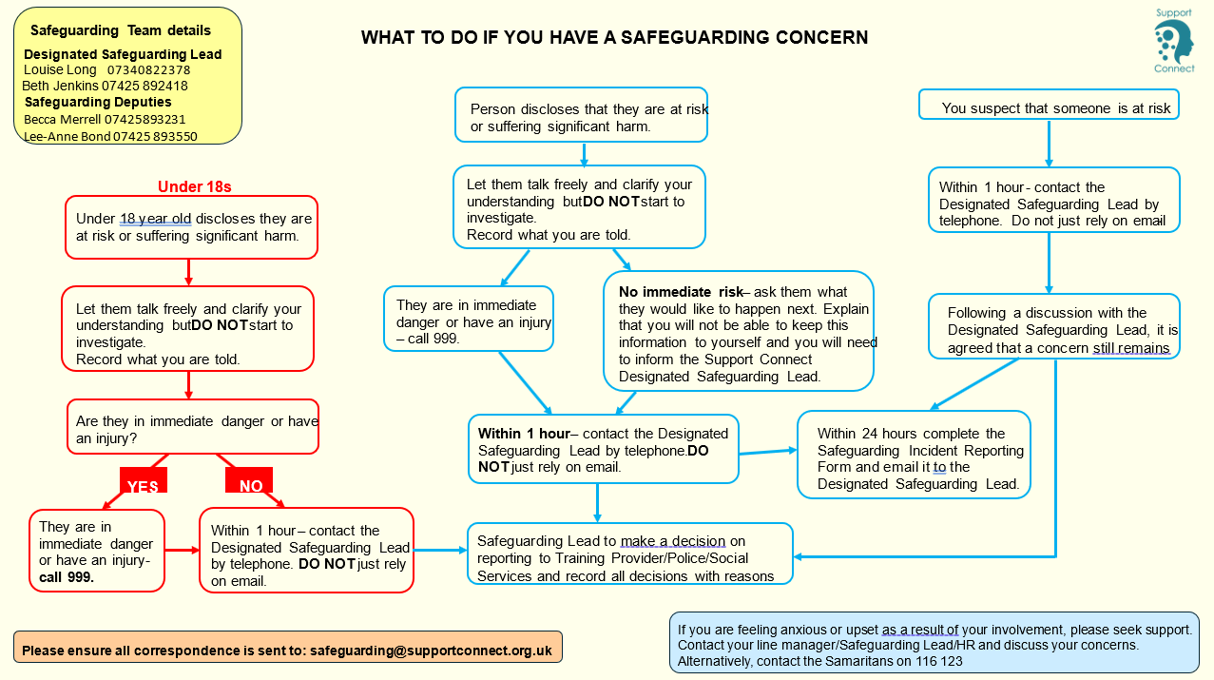
Safeguarding staff
Staff supervision and support
Support Connect is aware that any safeguarding cases can be distressing and that staff who have been involved in disclosures may find it beneficial to talk, in confidence to the DSL or a trained counsellor. Staff wishing to access counselling services should discuss this with the DSL.
The staff induction process includes familiarisation with safeguarding responsibilities and procedures to be followed if a staff member has any concerns about a person’s safety or welfare. Support Connect will provide appropriate supervision and support for all members of staff to ensure that:
- All staff are competent to carry out their responsibilities for safeguarding.
- All staff are supported by the DSL in the event of a safeguarding concern.
- All members of staff have regular reviews of their practice with their line manager where reflection on their practice is encouraged.
- All Well-being mentors receive regular consultation (supervision) with an in-house mentor to promote their well-being and have the opportunity to discuss complex cases and ethical dilemmas.
The DSL will signpost staff to external agencies for professional support if they so wish and is deemed necessary. All staff have access to the Employee Assistance Programme (HA Wisdom Wellbeing).
Allegations of abuse against staff
At Support Connect we take all allegations made against staff seriously and we will investigate as appropriate and in accordance with our Disciplinary procedure if necessary. All abuse allegations against staff will follow the same process as any disclosures made by learners.
If you have any concerns which involve the behaviour of a colleague this needs to be raised to the DSL as soon as possible who will determine the next steps. The DSL will also support all colleagues involved and deal with this sensitively and respectfully to minimize stress on the employees.
If through investigation the member of staff is deemed unsuitable to work with learners on a one-to-one basis the DSL will refer the incident to the Disclosure and Barring Service.
Support Connects internal reporting process.
The completion of the Support Connects Safeguarding Incident reporting is mandatory for recording and reporting all safeguarding concerns. The responsibility for the completion of this tool lies jointly with the individual staff member making the safeguarding referral and the DSL. The tool should be completed as soon as possible after the event. This will be emailed to you by the Safeguarding team, following the discussion of your concern.
The tool is essential in preventing any misrepresentation of your findings and should be completed and sent to the DSL within 24 hours of the suspicion arising. The report should be factual and should not include opinions or personal interpretations of the facts presented. The report should contain as much detail as possible, including any apparent physical signs of abuse or other circumstances which led to your suspicions, or the account given to you of abuse by the adult concerned, as accurately as you can record it, including details of any witnesses if there are any. The report should be signed, dated, and a copy stored in a secure place.
Working with Training Providers Safeguarding leads – Joined up working.
At Support Connect, in the instance of any safeguarding concerns, the DSL of Support Connect will make a judgement as to how and if it’s necessary to inform the Training Providers safeguarding lead. If deemed necessary, the DSL of Support Connect will manage the communications between them. We will always try to gain your consent to share this information.
At the start of the agreement with Training Providers, an initial meeting with the training provider and Support Connect takes place where policies and procedures are exchanged and discussed. This enables effective safeguarding of learners to be managed and escalated effectively.
Working with university students claiming Disability students’ allowance (DSA) for non-medical help (NMH)
At Support Connect, in the instance of any safeguarding concerns, the DSL of Support Connect will make a judgement as to how and if it’s necessary to inform the universities safeguarding lead. If deemed necessary, the DSL of Support Connect will manage the communications between them. We will always try to gain your consent to share this information.
At the start of the support all university students sign Support Connects terms and conditions, which outline that if a safeguarding incident occurs Support Connects designated safeguarding lead reserves the right to contact the university if they deem a student to be at risk.
Recruiting Staff
Support Connect has a robust recruitment process in place which makes sure that any member of staff that is appointed to a position is suitable to work with children and young adults. All new staff members go through an enhanced DBS check and supply two written references before commencing employment. For further detail on this please see our Safer Recruitment Policy.
Prevent, radicalisation and extremism
Support Connect seeks to protect its learners and staff from all messages and forms of violent extremism and ideologies including those linked to, but not restricted to: the Far Right/Neo Nazi, White Supremacist ideology, Islamic Extremist ideology, Irish Nationalist and Loyalist paramilitary groups and extremist Animal Rights groups.
The Prevent strategy is part of the Government’s counter-terrorism strategy. It aims to stop people from becoming drawn into terrorism or supporting terrorism. Whilst responding to the ideological challenge of terrorism and those who promote it. Support Connect does not consider that it has its own Prevent duty, however, all staff will take part in Prevent training as part of their induction and ongoing CPD. As such, Support Connect commits to:
- Ensuring that all staff are aware of their roles and responsibilities in preventing radicalisation and extremism.
- Operating an anti-bullying approach.
- Ensuring that equality, diversity, and inclusion are central to our work.
Channel referrals
The Channel program is a multi-agency approach aimed to support an individual who has been identified as at risk of being drawn into terrorism.
At Support Connect we have a responsibility to record and report any concerns of potential radicalisation. This is done through the use of our internal Incident Report.
In addition to this, the DSL will make a Channel referral to the local authority and inform the Training Providers DSL if appropriate.
In all Channel referral cases, we will liaise with the local Police for advice and guidance around the specific case. Chanel referral guidance can be found Channel duty guidance: protecting people susceptible to radicalisation (accessible) - GOV.UK (www.gov.uk)
Recording and Information Sharing
All organisations that store personal data must comply with the Data Protection Act (DPA) and the General Data Protection Regulations (GDPR).
Information about concerns of abuse includes personal data. It is therefore important to be clear as to the grounds for processing and sharing information about concerns of abuse.
Processing information includes record keeping. Records relating to safeguarding concerns must be accurate and relevant. They will be stored confidentially with access only to those with a need to know.
Sharing information, with the right people, is central to good practice in safeguarding learners. However, information sharing must only ever be with those with a ‘need to know’. This does NOT automatically include the person’s spouse, partner, training provider, or employer. Information should only be shared with the consent of the learner or if the learner does not have the capacity to make that decision and family/ friends/ training providers/ employers need to know to help keep the person safe.
The purpose of Data Protection legislation is not to prevent information sharing but to ensure personal information is only shared appropriately. Data protection legislation allows information sharing within an organisation. For example:
- Anyone who has a concern about harm can make a report to an appropriate person within the same organisation.
- Case management meetings can take place to agree to co-ordinate actions by the organisation.
There are also many situations in which it is perfectly legal to share information about adult safeguarding concerns outside the organisation. Importantly personal information can be shared with the consent of the learner concerned. However, the learner may not always want the information to be shared. This may be because they fear repercussions from the person causing harm or are scared that they will lose control of their situation to statutory bodies or because they feel stupid or embarrassed. Their wishes should be respected unless there are overriding reasons for sharing information. The circumstances when we need to share information without the learner’s consent include those where:
- It is not safe to contact the learner to gain their consent – i.e., it might put them or the person making contact at further risk.
- You believe they or someone else is at risk, including children.
- You believe the learner is being coerced or is under duress.
- It is necessary to contact the police to prevent a crime, or to report that a serious crime has been committed.
- The learner does not have the mental capacity to consent to information being shared about them.
- The person causing harm has care and support needs.
- The concerns are about a learner at risk living in Wales or Northern Ireland (where there is a duty to report to the Local Authority).
When information is shared without the consent of the learner this must be explained to them when it is safe to do so, and any further actions should still fully include them. If you are in doubt as to whether to share information, seek advice from the DSL and/or contact the Local Authority and explain the situation without giving personal details about the person at risk or the person causing harm. Any decision to share or not to share information with an external person or organisation must be recorded together with the reasons to share or not share information.
Appendices
Appendix I: Definitions
Abuse can be defined as any of the following. The definitions below have been informed by the Care Act 2014:
| Physical abuse | May involve hitting, shaking, throwing, poisoning, burning or scalding, drowning, suffocating, or otherwise causing physical harm to an adult. Physical harm may also be caused when a parent or carer fabricates the symptoms of or deliberately induces, illness in a child. |
|---|---|
| Emotional/ psychological/ mental abuse | Psychological abuse, which may consist of emotional abuse, threats of harm or abandonment, deprivation of contact, humiliation, blaming, controlling, intimidation, coercion, harassment, verbal abuse, isolation, and/or unreasonable and unjustified withdrawal of services or supportive networks. |
| Sexual abuse |
|
| Neglect and acts of omission | Neglect and acts of omission, which may include ignoring medical or physical care needs, failure to provide access to appropriate health, care, and support or educational services, and/or the withholding of the necessities of life, such as medication, adequate nutrition, and heating. |
| Child Sexual Exploitation (CSE) | Children Child Sexual Exploitation (CSE) is a form of child sexual abuse. It occurs where an individual or group takes advantage of an imbalance of power to coerce, manipulate or deceive a child or young person under the age of 18 into sexual activity (a) in exchange for something the victim needs or wants, and/or (b) for the financial advantage or increased status of the perpetrator or facilitator. The victim may have been sexually exploited even if the sexual activity appears consensual. Child Sexual Exploitation (CSE) does not always involve physical contact; it can also occur through the use of technology. Adults at risk Exploitation can be opportunistic or premeditated and involves unfairly manipulating someone for profit or personal gain |
| Modern slavery and Child Criminal Exploitation (CCE) | Encompasses slavery, human trafficking, forced labour and domestic servitude. Traffickers and slave masters use whatever means they have at their disposal to coerce, deceive, and force individuals into a life of abuse, servitude, and inhumane treatment. |
| Financial or material abuse | Includes theft, fraud, internet scamming, exploitation, coercion about an adult’s financial affairs or arrangements, including in connection with wills, property, inheritance, or financial transactions, or the misuse or misappropriation of property, possessions, or benefits |
| Discriminatory | Includes forms of harassment, bullying, slurs, isolation, neglect, denial of access to services or similar treatment; because of race, gender and gender identity, age, disability, religion, or because someone is lesbian, gay, bisexual, or transgender. This includes racism, sexism, ageism, homophobia or any other form of hate incident or crime. |
Domestic Abuse (including coercive control) | Includes an incident or a pattern of incidents of controlling, coercive or threatening behaviour, violence, or abuse, by someone who is, or has been, an intimate partner or family member, regardless of gender or sexual orientation. This includes psychological/emotional, physical, sexual, and financial abuse, so-called ‘honour’-based violence, forced marriage, or Female Genital Mutilation (FGM). The government has recently consulted on a proposal to introduce a mandatory reporting duty on forced marriage. If implemented, this will mirror the duty already in place to report known cases of FGM. |
| Self-neglect | Includes a person neglecting to care for their personal hygiene; health or surroundings; or an inability to provide essential food, clothing, shelter, or medical care necessary to maintain their physical and mental health, emotional well-being, and general safety. It includes behaviour such as hoarding. |
| Organisational / Institutional | Includes neglect and poor care practice within an institution or specific care setting such as a hospital or care home, or about the care provided in a person’s own home. This may range from one-off incidents to ongoing ill-treatment. It can be through neglect or poor professional practice as a result of the structure, policies, processes, and practices within an organisation. |
Specific Safeguarding Issues Support Connect’s approach aims to ensure staff and learners are aware of potential safeguarding issues and aware that issues can manifest themselves via peer-on-peer abuse, such as bullying/cyberbullying, gender-based violence/sexual assaults, and sexual exploitation and harassment. The following gives an overview of some of the specific safeguarding issues that may affect our learners. | |
| Sexual Harassment | Online sexual harassment and peer-on-peer online abuse can threaten a young person or vulnerable adult’s self-esteem and mental health and impact their achievement and progression. Upskirting is a form of sexual harassment that typically involves taking a picture under a person’s clothing without them knowing, viewing their genitals or buttocks to obtain sexual gratification, or causing the victim humiliation, distress, or alarm. Under the Voyeurism Act, upskirting offenders can now be arrested, face up to two years in prison and have their name placed on the Sex Offenders Register if caught upskirting. This includes instances where culprits say the images were taken in jest, as what may seem like harmless fun can have deeper consequences for both the victim and perpetrator. |
| Radicalisation | Refers to the process by which a person comes to support terrorism and extremist ideologies associated with terrorist groups. Staff are also required to look out for issues relating to witchcraft and religion and their implications for safeguarding. As defined in the Revised Prevent Duty Guidance for England and Wales. |
| Extremism | Is the vocal or active opposition to our fundamental values, including democracy, the rule of law, individual liberty and the mutual respect and tolerance of different faiths and beliefs. This also includes calling for the death of members of the armed forces. As defined in the Government’s Counter Extremism Strategy https://www.gov.uk/government/publications/counter-extremism-strategy |
| Terrorism | Is an action that endangers or causes serious violence to a person/people; causes serious damage to property; or seriously interferes or disrupts an electronic system. The use or threat must be designed to influence the government or to intimidate the public and is made for the purpose of advancing a political, religious or ideological cause. As defined in the Terrorism Act 2000 (TACT 2000) |
| Female Genital Mutilation (FGM) | Professionals in all agencies, and individuals and groups in relevant communities, need to be alert to the possibility of a girl being at risk of FGM or already having experienced FGM. FGM comprises all procedures involving partial or total removal of the external female genitalia or another injury to the female genital organs. It is illegal in the UK and a form of child abuse with long-lasting harmful consequences. There is a range of potential indicators that a child or young person may be at risk of FGM. Individually, they may not indicate risk. However, if there are two or more indicators present, this could signal a risk to the child or young person. Victims of FGM are likely to come from a community that is known to practice FGM. Professionals should note that girls at risk of FGM may not yet be aware of the practice or that it may be conducted on them, so sensitivity should always be shown when approaching the subject. If a member of staff, in the course of their work, discovers that an act of FGM appears to have been carried out on a girl under the age of 18, this must be reported to the police and the DSL immediately. |
| Heavy Shepherding | Heavy shepherding, sometimes called authoritarian leadership or spiritual abuse within Christian contexts, refers to an excessively controlling style of church leadership or pastoral oversight. In such settings, leaders may demand disproportionate submission from congregants, exert undue pressure in personal matters, or use Scripture manipulatively to maintain control. |
| Forced Marriage | A clear distinction must be made between a forced marriage and an arranged marriage. In arranged marriages, the families of both spouses take a leading role in choosing the marriage partner but the choice of whether to accept the arrangement remains with the young people. In forced marriage, one or both spouses do not consent to the marriage, or consent is extracted under duress. Duress includes both physical and emotional pressure. |
| Bullying | Individuals or groups seek to harm, intimidate or coerce other adults. All incidents of bullying are taken seriously. |
| Peer-on-peer abuse | Peer-on-peer abuse is most likely to include, but may not be limited to, bullying (including cyberbullying), gender-based violence/sexual assaults, upskirting, initiations and hazing, and sexting. Peer-on-peer abuse is harassment and aggression in which a young person intentionally threatens, harms, or causes distress to another young person. This behaviour is intentional, repeated, and designed to hurt or threaten. Peer abusers seek to abuse and terrorise defenceless others who may not have the ability or resources to help themselves. Thus, peer abuse requires a power imbalance. Peer abuse can be direct, in physical or verbal forms, or indirect, in such forms as exclusion, gossiping, and rumours. Signs of peer-on-peer abuse include:
Peer abuse has serious effects. Victims can suffer injury, depression, and lowered self-esteem, and many contemplate suicide. Peer abusers are also at risk of alcohol and drug abuse, delinquency, and criminal behaviour. Peer abuse affects many people, and victims and bystanders are often afraid to report abuse and feel unsafe or unsupported. |
| Serious violence | All members of staff should be aware of the indicators that may signal that an individual is at risk from or involved with serious violent crime. Indicators may include increased absence from support sessions, signs of self-harm, or significant changes in well-being/signs of assault. When an individual begins to show signs of exploitation or vulnerability to exploitation, we should be able to intervene as early as possible to help reduce the risk factors and increase protective factors. |
| Stalking | Stalking can be defined as persistent and unwanted attention that makes someone feel pestered and harassed. It includes behaviour that happens two or more times, directed at or towards a person by another person, which causes them to feel alarmed or distressed or to fear that violence might be used against them. |
| Substance abuse | Substance abuse refers to the abuse of illegal substances, such as marijuana, heroin, cocaine, or methamphetamine. Or it may be the abuse of legal substances, such as alcohol, nicotine, or prescription medicines. Alcohol is the most common legal drug of abuse. |
| Discriminatory abuse | This includes forms of harassment, slurs, or similar treatment. This will be based on race, gender and gender identity, age, disability, sexual orientation, or religion. |
| Cuckooing | Is a crime where drug dealers take over the home of a vulnerable adult to use it as a base for criminal activity. |
| County lines | Gangs and organised criminal networks are involved in exporting illegal drugs into one or more importing areas in the UK. They exploit vulnerable adults to move and store drugs and money. |
| Honour based violence | Violence committed against a family member is motivated by the perceived need to restore standing within the community, which is presumed to have been lost through the behaviour of the victim. |
| Online abuse/cyberbullying | This includes the use of the internet, social networking sites or mobile phones to harass, intimidate or cause harm to others. |
Appendix II: Designated Safeguarding Lead role description
Purpose of the role
To take the lead in ensuring that appropriate arrangements for keeping children, young adults, adults, and staff safe are in place at Support Connect.
To promote the safety and welfare of children, young adults, and adults involved in Support Connects activities at all times.
Designated Safeguarding Lead
1. Role
1.1 The Designated Safeguarding Lead, (DSL) has overarching responsibilities regarding safeguarding for Support Connect Ltd. They will have an in-depth knowledge of safeguarding guidance in relation to adults and young people, (such as Adult Safeguarding, Keeping Children Safe in Education, and Working Together to Safeguard Children) and related pieces of legislation (e.g. the Children Act 1989) that we must follow.
1.2 The DSL will apply their knowledge to help implement and maintain safeguarding procedures and policies, as well as be alert to safeguarding issues on a day-to-day basis.
1.3 They will ensure that systems are in place to ensure that staff have received appropriate training, that their own training is up to date, that safe recruitment practices are sufficient, and that all actions are in the best interest of safeguarding.
1.4 If the DSL identifies any concerns or another member of staff raises them, the DSL will coordinate Support Connect Ltd's response to the concern.
1.5 The DSL will work with the Deputy Safeguarding Officers to ensure there is a consistent approach to safeguarding practices within Support Connect and their stakeholders.
2. Responsibilities
2.1 The DSL, together with the Deputy Safeguarding Officers, will be available for all staff to discuss any safeguarding issues or concerns.
2.2 The DSL and the Deputy Safeguarding Officers will ensure that there is always a member of the Safeguarding Team available – e.g., being aware of each other’s annual leave.
2.3 The DSL will ensure that Support Connect staff understand and follow safeguarding procedures.
2.4 The DSL will make sure that Support Conned Ltd Safeguarding Policy and Procedure are up to date with the most recent statutory guidance, and that everyone who has safeguarding duties is familiar with any updates.
2.5 The DSL will ensure that safeguarding policies and procedures are reviewed annually.
2.6 They will ensure that staff are trained in safeguarding and know how to spot and raise concerns.
2.7 The DSL will ensure that cases of suspected or actual safeguarding concerns are referred to the appropriate agencies and will co-ordinate/gather further information and evidence, if requested, as part of the multi-agency response. This DSL will:
- Assess and clarify the information
- Make referrals to statutory organisations as appropriate
- Consult with and inform the relevant members of the organisation’s management team.
- Follow the organisation’s safeguarding policy and procedures
2.8 Liaise with, pass on information to, and receive information from external agencies such as:
- The local authority Safeguarding team
- Child protection services
- Training providers
- The emergency services
- The police.
- Consult the NSPCC Helpline when support is needed, by calling 0808 800 5000 or emailing help@nspcc.org.uk.
This includes making formal referrals to agencies when necessary.
2.9 Work closely with the management committee/board and deputy safeguarding officer to ensure they are kept up to date with safeguarding issues and are fully informed of any concerns about organisational safeguarding.
2.10 The DSL will undertake regular refresher training themselves to ensure their safeguarding knowledge is as up to date as possible and in line with new guidance.
2.11 The DSL will act as Support Connect Ltd main point of contact for Training Providers/Employers where there is a safeguarding concern, whether actual or suspected.
2.12 They will ensure that systems are in place for recording and monitoring purposes, this is done in line with legal requirements, confidentiality, and GDPR.
2.13 The DSL will work with the General Manager/HR to make sure that Support Connect Ltd has sufficient safer recruitment procedures.
2.14 - Report any cases to the Disclosing and Barring Service (DBS) where it has been deemed that an individual is unsuitable to work with Children or Adults at risk.
2.15 The DSL will report any identified learning arising from concerns to the Senior Management Team and make suggestions on any training/actions required.
2.16 The DSL and the DSOs will ensure that staff who are affected by disclosures or investigations are appropriately supported.
2.17 Planning and arranging safeguarding quarterly team meetings with DSOs and attending management meetings as appropriate.
Appendix IV: Flow chart (what to do if you have a safeguarding concern)
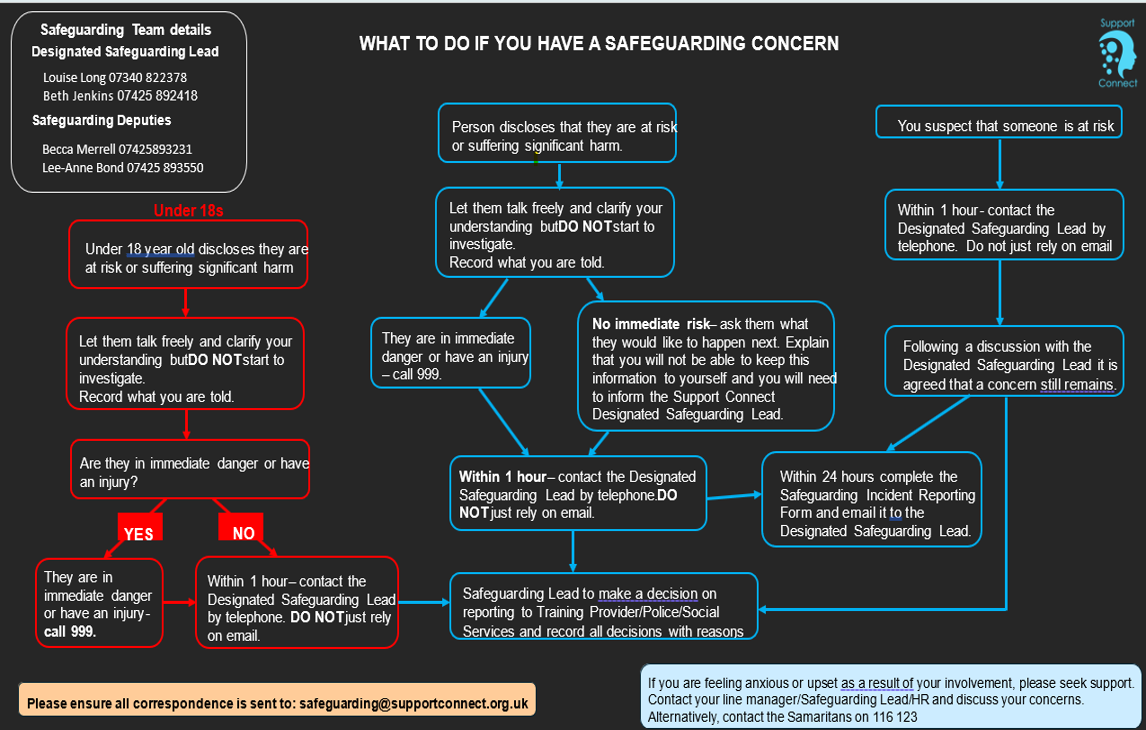
Appendix V: Safeguarding Incident Reporting form
This form is to be used by Support Connect staff to record any disclosures or suspicions of abuse.
Within the first hour of disclosure your concerns need to be reported verbally to either of the Designated Safeguarding Leads Louise Long on 07340 822378 or Beth Jenkins on 07425 892418.
In Louise/Beths absence please contact any of our deputies.
The completed form should then be sent directly to the Designated Safeguarding Lead – Louise Long/Beth Jenkins at safeguarding@supportconnect.org.uk within 24 hours of the disclosure.
| Section 1: Details of the person completing the form/you | |||||||||||
|---|---|---|---|---|---|---|---|---|---|---|---|
| Your name | |||||||||||
| Your job role | |||||||||||
| Your telephone number | |||||||||||
| Your email address | |||||||||||
| Section 2: Details of the person you are concerned about | |||||||||||
| Name | |||||||||||
| Address | |||||||||||
| Telephone number | |||||||||||
| Date of birth | |||||||||||
| Training provider/ University | |||||||||||
| Section 3: Details of the allegations/suspicions/concerns | |||||||||||
Are you recording, please highlight one of the 2 below:
| |||||||||||
| Date and time of disclosure | |||||||||||
| Date and time of the incident | |||||||||||
Details of the allegation/suspicion/concerns. Please state exactly what you were told or observed including what you said. Use the person’s own words as much as possible. Please give details about what you have seen/been told/other that makes you believe the person is at risk of harm or is being abused or neglected. Please highlight if your concerns relate to the learner being an abuser. (include dates/times/evidence/facts from records etc.)
| |||||||||||
| Section 4: Learners’ views | |||||||||||
Have you discussed your concerns with the learner? What are their views, What have they stated about what they want to happen and what outcomes they want?
| |||||||||||
| Section 5: Risk to others | |||||||||||
Is there a risk to other people? If yes please give details
| |||||||||||
Any other relevant information. Previous concerns, any other facts, or other vulnerabilities that need to be highlighted.
| |||||||||||
| |||||||||||
| Section 8: To be completed by the DSL | |||||||||||
| Reference number | |||||||||||
| Actions: To be completed by the DSL | |||||||||||
Has this concern need to be referred to an outside agency? If yes please give details e.g. Local Area Safeguarding team, Prevent co-ordinator, Police. Please also note if the Police are already involved.
Has the learner concerned given consent? For yes or no please explain why.
| |||||||||||
Actions taken so far:
| |||||||||||
Subsequent tasks allocated to Support Connect:
| |||||||||||
Outcome:
| |||||||||||
| Does the Training provider/university need to be informed? | Yes | No | |||||||||
| Does the person reporting the concern require support? | Yes | No | |||||||||
Appendix VI: Sources of information and support
Below is a list of organisations and charities to signpost learners to when facing safeguarding disclosures.
Ann Craft Trust (ACT)
A national organisation providing information and advice about adult safeguarding.
Tel: 0115 951 5400
Email: Ann-Craft-Trust@nottingham.ac.uk
Website: www.anncrafttrust.org
Respect - Men’s Advice Line
For male victims of domestic abuse
Tel: 0808 801 0327
Website: https://mensadviceline.org.uk/
Galop
National LGBT+ victims and survivors of abuse and violence support
Tel: 0800 999 5428
email help@galop.org.uk
Refuge
National 24Hour Freephone Domestic Abuse Helpline
Tel: 0808 2000 247
Website: www.nationaldahelpline.org.uk/Contact-us
Campaign against living Miserably (CALM)
Provides a helpline, online and WhatsApp chat, as well as information and support, for anyone affected by suicide or suicidal thoughts.
Tel: 0800 58 58 58
Website: https://www.thecalmzone.net/
Carers UK
Advice and support for anyone who provides care.
Tel: 0808 808 7777
Websites: advice@carersuk.org and https://www.carersuk.org/
National Suicide Prevention Helpline UK
Helpline offering a supportive listening service to anyone with thoughts of suicide. Open from 6pm to midnight every day.
Tel: 0800 587 0800 or 0800 689 0880
Website: https://www.spuk.org.uk/national-suicide-prevention-helpline-uk/
Papyrus HOPELINEUK
Confidential support for under-35s at risk of suicide and others who are concerned about them. Open 24 hours, 7 days a week.
Tel: 0800 068 41 41
Website: https://www.papyrus-uk.org/
Respond
Respond provides Support for people with a learning disability, autism, or both who are victims of sexual abuse.
Tel: 020 7383 0700
Website: https://respond.org.uk/independent-sexual-violence-advocacy-isva-service/
Stop Hate Crime
Works to challenge all forms of Hate Crime and discrimination, based on any aspect of an individual’s identity. Stop Hate UK provides independent, confidential, and accessible reporting and support for victims, witnesses, and third parties.
Hate crime reporting app which is available to download through the website.
24-hour service available by area within the UK. See the websites for the relevant contact details.
Website: https://www.stophateuk.org/
Susy Lamplugh Trust
The Trust is a leading authority on personal safety. Its role is to minimise the damage caused to individuals and society by aggression in all its forms – physical, verbal, and psychological.
Tel: 020 7091 0014
Email: info@suzylamplugh.org www.suzylamplugh.org
Website: https://www.suzylamplugh.org/
Victim Support
Provides practical advice and help, emotional support, and reassurance to those who have suffered the effects of a crime.
Tel: 0808 168 9111
Website: www.victimsupport.com
Women’s Aid Federation of England and Wales
Women’s Aid is a national domestic violence charity. It runs a domestic violence online help service and online chat service.
It also has a support service through email - helpline@womensaid.org.uk
Website: www.womensaid.org.uk/information-support
The Mix
The Mix is a free information and support service for those under 25s. The Mix offers support on a range of topics including mental health in the UK. The service has a 1-2-1 online chat facility and a crisis messenger service through its website.
Tel: 0808 808 4994
Website: https://www.themix.org.uk/
Samaritans
A 24/7 confidential telephone service for anyone facing difficulties.
Tel: 116 123
Website: https://www.samaritans.org/